Article
Recycled vs Compostable vs Biodegradable Mailers
Three terms that are used interchangeably and mean entirely different things, what each requires you to evidence, and which is defensible in practice.
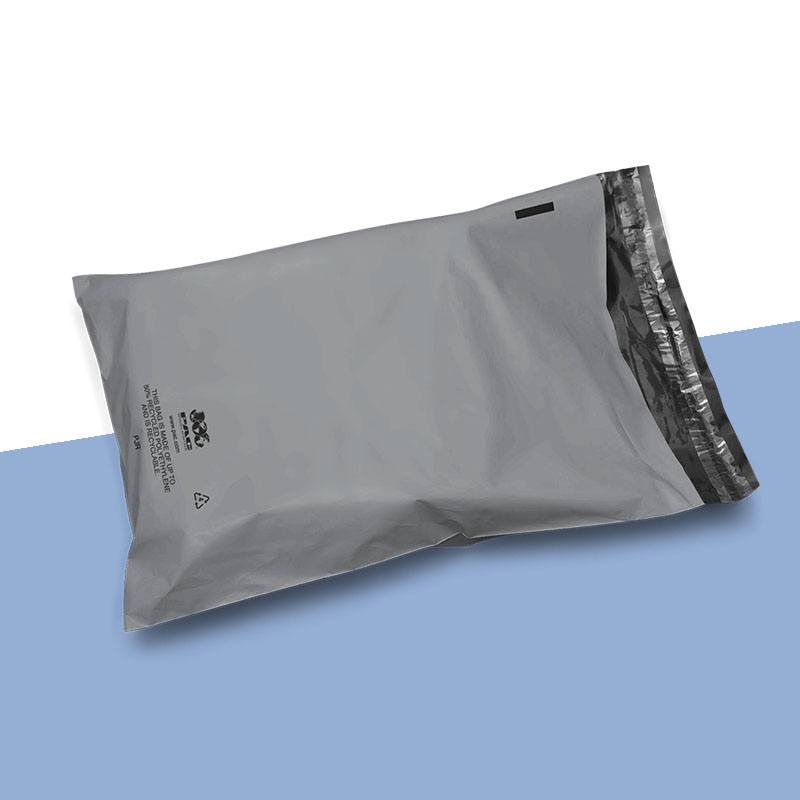
Three words, used more or less interchangeably in packaging marketing, describing three entirely different things. The confusion is not accidental — vagueness is commercially useful to whoever is selling — but it puts the risk on the business that prints the word on a bag.
This is what each one actually commits you to.
Recycled content is about the beginning
Recycled content describes where the material came from. It says nothing whatsoever about what happens to it afterwards.
There are three feedstocks, and a supplier saying “recycled” means one of them:
- Post-consumer. Material recovered after it was used and discarded by a household or business. This is the one that diverts waste from disposal, and it is what most buyers assume they are getting.
- Post-industrial. Offcuts, trim and rejected material recovered inside a manufacturing process before it reached anyone. Legitimately recycled, but it was never going to landfill, so the environmental argument is considerably weaker.
- Blended. A proportion of recycled material combined with virgin polymer, which is the usual arrangement because recycled feedstock alone affects how film runs and performs.
A claim that names the feedstock and the proportion, and can be traced to a document, means something. A claim that says only “recycled” means almost nothing, and the difference between the first two is where most of the meaning sits.
This is the easiest of the three to substantiate, because the evidence exists at the point of manufacture and does not depend on anything a customer does afterwards. What we confirm per order is set out on the recycled mailer page.
Compostable is about a specific process
Compostable describes an end-of-life route. It is a claim that the material will break down in a managed biological process — one with sustained temperature, moisture, oxygen and time held within defined ranges.
That process has to exist and your customer has to be able to reach it. This is where most compostable packaging programmes come apart: a brand buys the material, prints the word, and the bag goes into general waste because the customer had nowhere else to put it. The environmental benefit does not happen, and a claim has been made that the outcome does not support.
There is a second distinction inside the term. Industrial composting happens at a facility built to hold those conditions; home composting happens in a domestic heap at much lower temperatures. A material can be assessed for one and not the other, and they are not interchangeable. A supplier who says “compostable” without saying which has not answered the question.
Before choosing this route, the questions are: what can my customers actually access, what will I tell them to do with it, and what documentation exists for the specific material. The compostable mailer page states which of those we can answer and which we cannot.
Biodegradable is the least defined
Almost everything biodegrades eventually under some set of conditions. That is why the word, used on its own, describes a property every material has and tells a customer nothing.
A defensible degradation claim answers four questions:
- Under what conditions? Industrial composting, home composting, soil, marine, landfill. These are radically different environments and a material rarely performs the same in all of them.
- How completely? Whether it breaks down fully or fragments into smaller pieces. Fragmentation is not biodegradation, and additive-driven fragmentation has attracted specific regulatory concern.
- Over what period? A timeframe, tied to the conditions named above. A timeframe without conditions is meaningless.
- Assessed by whom, against what method? A supplier saying so is not an assessment.
If a supplier cannot answer all four for the specific film they are selling you, the claim is not one you should print — which is why the biodegradable mailer page makes no timescale claim at all. This is also why unqualified degradation language is among the most frequently challenged statements in packaging across the markets we serve.
Comparing them on what matters
Set side by side, the three separate cleanly on four questions.
| Recycled content | Compostable | Biodegradable | |
|---|---|---|---|
| Question answered | What was it made from | Where can it go after use | Will it break down, eventually |
| Depends on customer infrastructure | No | Heavily | Not specified |
| Evidence required | Feedstock type and proportion | Assessment against a defined process | Conditions, completeness, timeframe, method |
| Difficulty of substantiating | Straightforward | Possible, but the route must exist too | Hard without full qualification |
The pattern is consistent. The route that is easiest to evidence is also the one that does not depend on anything outside your control, and the route with the strongest story is the one most likely to deliver nothing if the infrastructure is absent. The terminology used across all three is defined term by term.
Why we publish no numbers
There is no recycled percentage, certification mark or decomposition timescale anywhere on this website. That is deliberate.
Content varies by film, by production batch and by market. A single figure published here would be a figure we could not honour for every order, in a category where regulators in every market we serve treat unsupported environmental claims seriously.
What we do instead is go to the supplier of the specific film for your order, ask what is documented, and show you the answer before you commit — including when the answer is that nothing is. That reasoning is set out in full on the sustainability page. It is a less appealing page than one covered in green symbols, and it is the only version that leaves you able to defend what you print.
Recyclability is a fourth question
Worth separating out, because it gets conflated with recycled content constantly.
Recyclability is about whether your customer can get the material collected and reprocessed where they live. Flexible plastic film is generally not accepted in household kerbside collections across the markets we serve, and is instead collected at supermarket or retail drop-off points where those exist — with availability varying by area.
So a mailer can have high recycled content and still be difficult for a household to recycle. Both statements can be true at once, and printing one while implying the other is where a lot of packaging copy goes wrong.
If recyclability is what your customers actually care about, the honest thing to print is where the film can be taken. An accurate instruction gets followed; a general symbol implying a collection that does not exist locally causes more harm than saying nothing. Which route suits a given range is set out across the sustainable mailer options.
The claim you can always make
There is one category of environmental claim that requires no supplier documentation at all: statements about your own operation.
Right-sizing so parcels stop shipping air. Removing a component from a pack. Specifying a resealable closure so a return needs no second bag. All of them reduce material measurably, all of them can be evidenced from your own before-and-after data, and none of them depends on anyone else’s paperwork.
They are also, for most operations, larger reductions than switching material would produce. That is not the answer the packaging industry generally leads with, and it is the one that holds up.
Where to start, and what we will supply documentation for, is set out on the sustainability position page.
Notes on sources
- Environmental claims guidance in the served markets
- The United States, United Kingdom, Canada and Australia each publish guidance on environmental marketing claims, and the requirements differ. Check the guidance applying to the market you sell into before printing any claim; this article is not legal advice.
- Local collection availability
- Whether flexible film can be recycled where a customer lives depends on the collection schemes operating in that area. Verify locally rather than relying on a general statement.
Questions this raises
Which of the three should I choose?
They answer different questions, so there is no single right answer. Recycled content is the easiest to evidence and does not depend on infrastructure you do not control. Compostable has the strongest story and the hardest execution. Biodegradable, used without qualification, is the hardest to defend.
Does recycled content mean the mailer is recyclable?
No, and conflating them is the most common error in this area. Recycled content describes what the film was made from. Recyclability describes whether your customer can get it collected, which depends on local infrastructure rather than on the material.
Why will you not publish a recycled percentage?
Because content varies by film, by batch and by market, and a figure on a web page could not be honoured for every order. We confirm the feedstock type and proportion in writing on your quotation for the film actually being supplied.
Choose a route without guessing at the claims
Tell us what you need to be able to say to your customers. We will explain what each film supports, confirm composition in writing, and quote it.